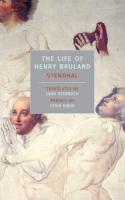
 The Life of Henri Brulard by Stendhal (1890).
Appreciation of Stendhal’s The Life of Henri Brulard by William Boyd
“Stendhal” is a pseudonym. The author’s real name was Marie-Henri Beyle. Stendhal is best known for the great and classic 19th century French novels The Red and the Black (1830) and The Charterhouse of Parma (1839). He was born in Grenoble in 1793 and died in Paris in 1842.
I have chosen his strange autobiography instead of one of his novels because I think it is an extraordinary 19th century text, one that was only published in 1890, long after Stendhal’s death. It’s not clear why Stendhal chose the title, however. Very quickly he reveals that he himself is “Henri Brulard”—another false identity—and in a way this fact illustrates the astonishing modernity of this memoir. It is both playful, in a literary sense, and very frank.
Stendhal hated his father (and doesn’t spare him) and he hated his native city, Grenoble—“The capital of boredom.” Moreover, the book’s narrative is the opposite of chronological. Ostensibly an account of the author’s early years, it in fact skips forward and back through Stendhal’s life as he pleases, almost as if it were a record of his meandering thoughts. It is also illustrated with copious little hand drawn sketches, done by Stendhal himself—plans of houses or city streets, schematic landscapes and so forth, that flesh out the story of his life.
The whole concept of the book is wonderfully out-of-left-field. Stendhal’s honesty is very compelling and his spirit seems very contemporary—all his grumbles and irritations, his love affairs—requited and unrequited—his professional ups and downs are candidly and mercilessly recounted. You could imagine Stendhal living today—the tone of voice is so surprisingly contemporary—as there is nothing remotely dated about this autobiography thinly disguised as a biography. Even if you knew nothing about Stendhal or his famous novels you would be held and beguiled, I believe. A unique piece of 19th century life-writing, as we would now describe it.
Total Points: 3 (WBoyd 3)